 Home Home |
Contact us | Sonic Thrust Records | Buy Jay's Albums |
|
|
by JaR, i.e. Jay Graydon and Randy Goodrum. Video featuring the title song on the first JaR album - SCENE 29. This song has a brilliant film noir lyric. You may want to read the story behind the concept of the SCENE 29 album cover as well.
During a period in Jay's life his main interests were electronics and bowling. His father Joe Graydon had a radio show on KDAY in the early 60's and every Saturday he would take his son to the station and little Jay would engineer Dad's show. Joe would sit at the "guest mic" and Jay would read the "log" and play the records listed as well as running the tape machines that were used to play the "spots" (commercials). Jay loved engineering the show and here he tells you more about the techniques used in those days! I once read in an interview with Marty Walsh that he was very grateful to you for helping him during his first years in music biz. You became his mentor recommending him for gigs. When you were kids you were in a band with his brother Dan and you were the bass player (!). Can you tell us a little bit more about this, Jay? * Marty Walsh is a very good guitar player. As he mentioned, when we were kids, I was in a band with his brother Dan (guitar), Bob Hogins (a very good keyboard player), Bob Carrafield (drums), and I played bass. I also played guitar, keyboards and drums as each of the players took turns being the front man lead singer when we did our "show set." This band was called the "GO GO'S" and most all of the gigs were for the Marines (Camp Pendleton in Oceanside California). The gigs were on the weekends but the bad part is this was during the Viet Nam war! Marty's brother Dan is also a very good guitar player and wrote a few hit songs over the years. My nick name was Jake and Dan was the guy to come up with JAKE THE RAKE. Marty's father was a great guy! During rehearsal breaks at Dan's house, Gene (Marty's father) would talk to me about how to deal with working "casual" gigs (weddings and the like). Gene hired me to play a few casuals and one gig was a beauty contest. I was hired to play guitar and sing "EVERYTHING IS COMING UP ROSES" and "THE DAYS OF WINE AND ROSES." Obviously, roses was part of the theme of the event. I have always appreciated quality melodic standards such as these songs but playing casuals was like working a boring day job since most of the musicians played "square" (a term which basically means "a dated style of playing"). Regarding Marty and recommendations for gigs, when I was bailing out of casual gigs, I recommended Marty since he knew the standards (on guitar) and could also sing the pop hits of the era. When I started producing records, I recommended Luke, Marty and a few other great guitar players (Dan Sawyer, Dan Fergusen) for studio work. Since Luke took off like a lightening bolt, Marty got his chance to establish himself. Both Dan's were already on their way before Marty. *
Dan Walsh, being one of the members of the GO GO'S, has provided us with some cool photos from that era. We will start with Cabin Fever featuring the guys in their rented Oceanside house (2 hours from LA). They have aged (i.e. the pics) and it might be hard to figure out who is who, but Dan can give us the full details: "Just some thoughts on the memories. It was a great time, I think it was '66---we were all in our later teens. After the Friday night gig we would bop around the town all Saturday, ending up before the gig that night at Der Wienerschnitzel, happily gulping down those lousy hot dogs--ha ha-- It was cool. Our Cabin was right on the beach which was great. Sometimes before the gig started, our Manager, Dorothy Verkler would bring in a bus load of girls and the Marines would go nuts. The band was good and versatile. We did everything from Byrds tunes to James Brown." Dan shares more memories with us... "We were playing for the Marines and one time before Bob Hogins was going to announce the name of the next song we were going to do, he made the "mistake" of saying "allright boys and girls" --- An immediate, loud rumble from the audience and Bob quickly corrected --- "I mean Men" --- then everything was back to normal. Here are two pictures from Dan - Out On The Town and Lunchtime - which will put you back in time and into the setting and mood of this era even if the ravages of time have treated the photos unkindly. In general though they were a good audience to work for. --- Short Story --- We were pretty raucous in our hotel rooms -- young guys -- rock group -- whatever, but I remember only three decent hotel/motels in Oceanside at the time. We were asked not to come back to all of them - I remember one night at a place called the Bridge Motor Inn - a while after we got into our room, we started grabbing chunks of toilet paper, getting them soaking wet and chucking them at each other, and against the walls - it was a ton of fun but we didn't do the room any good --- ha ha --- also somehow the shades in the room that night {thin metal shades that you would pull up/down} got quite bent out of shape - I can't remember for sure but I think we may have {or our Manager} had to write a check for the condition of the room. Oh well, no excuse --- except ---- "Rock and Roll made us do it!" One of our sets was a "show set." During the show set, I was the utility player moving from instrument to instrument. When Hogins sang James Brown songs, he would front the band and I would play electric piano (along with the bass part in the low register of the piano). When Carrafield fronted the band (sang), I would play drums. Other than the show set, on songs that needed two guitars, I played guitar and Hogins played left hand bass parts on piano. The band was good considering our age - all of the players are musically gifted and the band was better than average. Bob Hogins was the most musically gifted of all the guys. Last I heard, he is a musical director for a church somewhere in California. Dan is a very good guitar player and became a successful songwriter. Bob Carrafield is very good drummer and went on to play with a local band that was extremely good. Last I heard, he is playing with bands in Orange County California. After the band split up, that was the last time I saw Dick Gerstal. Regarding the picture with my 56 Buick, this was my first car and I paid 25 bucks for it. The reason it only cost 25 bucks was it needed major repairs. Since I could not afford the repairs, I drove it for two years until the engine blew up. We did not record this band but I do have a tape (laying around somewhere) with Hogins, Carrafield and me that was recorded in my Mothers living room. We recorded two songs - OUT OF SIGHT (a James Brown song) and KOKO JOE (can't remember who wrote the song). I seem to remember that I had borrowed a two track recorder and the recording was done using the "sound on sound" technique. If I can find the tape, and we put it up on the sight, I will explain how the sound on sound technique works. The GO GO'S was my first and last bass gig. I still own the bass and it was the bass David Hungate played on the SURFTONE album. By the way, Dan was the guy that gave me the nickname "Jake the Rake." *
There is a lot to tell from recording sessions over the years. Picking out memorable dates isn't that easy to do, since there were so many sessions, but a few of them stands out and Jay is willing to share with us some of his most enjoyable times. * I will tell you about one that flashed into my head. It was a Barry White session in the mid 70's. Ed Green on drums, Wilton Felder on bass, Sunny Burke on piano and 5 guitar players. I think the guitar players were Dean Parks, David T Walker, Wah Wah Watson, Ray Parker and myself. What was special is that even though Gene Page wrote the charts, Barry would come up to each player and sing the part to play. He would sing to Ed the high hat and kick part. Then would sing Wilton the bass line. Barry would sing a 2 bar pattern to each guitar player consisting of syncopated single notes. Sometimes the lick would like to be played in 3rds. When going into the control room to listen to the first rough playback, the guitar parts worked incredibly well together and was R&B genius! Barry has the gift to come up with fresh parts for every song. Most musical! On some of the songs, Barry would tell Wah Wah to play his thing along with David T but the other guys would get these little parts assign to them and love it! The only drag is that these parts would get buried in the mix since Barry's records had strings and horns for days which did not allow the space for these parts to be heard. If you took them away, you would notice something was gone so they had a purpose. I wish I had a cassette of these tracks! They were the best R&B guitar parts of the era! *
Are you a self-taught music arranger, working mainly from feeling or a "guts sense" or do you have a formal education as well?
* Both in a sense. I have been very lucky regarding meeting people that helped my musical growth. While playing surf music in my first band, I met Jim Allen, (bass /guitar), Harry Van Diepen, (guitar) and Cliff Pasta, (guitar). We became friends and these guys were good players for the era. Their band was the best local band. Both Harry and Cliff taught me basic guitar stuff but Jim was the scholar of the group. Jim has "perfect pitch" which is a gift from God. "Perfect pitch" means that he can hear a note and immediately realize the name of the note. This gift has nothing to do with singing "perfectly in tune" as that is another very rare gift. Since I was not born with "perfect pitch", I worked extremely hard as to develop the next closest thing which is relative pitch. I am getting ahead of the story. Jim and I would listen to a record like Misty and he would name the chord changes as they went by. I WAS AMAZED! I wanted to be able to do this. He taught me basic chord structure along with "extensions." He would play chords and ask me to identify the structure like a major 7th chord, dominant 7th chord, diminished, augmented and much more. I was in heaven since I caught on fast and could now do "take downs" of songs on records. This is "relative pitch" which means that after the first note is established (lets say the first note is "c"), I would be able to name the next single note played or sung. Jim might play an "F#" and I would think about the "c" scale and then realize that it is the sharp 4th or flat 5th of the scale and name "F#". I spent hours listing to the radio practicing picking out single notes and chord structures. The next step was to figure out how to discover the "key" of a song without the help of an instrument. I discovered the highest note I could whistle is a "C". The lowest note I could sing was a "E". This made it easy to find the "key" using relative pitch. Another concept for finding the first note is to visualize the piano keyboard in my head. I would test myself constantly and this became 2nd nature. In a sense, I developed "a poor mans perfect pitch."
My high school music teacher, Robert Rose, was a gift from God! He taught me the basic
arranging concepts for horns. I began writing arrangements for the dance band which consisted
of 4 trumpets, 4 trombones, 5 saxes and rhythm section. I was at the point that I could
imagine the lead line parts in my head and write them out and then harmonize with the help of
a piano. When attending college, things really open up musically. *
How was it , Jay, did you break all the session records in the 70's, or is Larry Carlton still the recordholder? I can't remember seeing it in "Guinness...."
* One year I played over 800 sessions which may be a record. During the 70's, there was so much work for top studio players and especially for guitar players since there were usually 2 or more guitar players on tracking dates. Overdub sessions added to the work calls. It was common to get called for 30 to 40 sessions a week. I would typically accept 20 sessions (4 a day, 5 days a week). I would fit in quick overdub dates with a few people on a regular basis. The main producer was Mike Lloyd. This was great since I would call him if I had finished a session early. If he was able to shift things, I would go to his studio and throw on a solo or do parts. I would finish in 30 minutes or so. One time he called me to overdub acoustic guitar on 8 songs. He put the charts on the music stand and recorded the run down and then double the part. I was out of there in less than an hour. Much fun working for Mike. A very cool thing about working at Mike's studio was I would see Groucho Marx sitting on a park bench in Beverly Hills quite often! So many record date stories to share at a later time. *
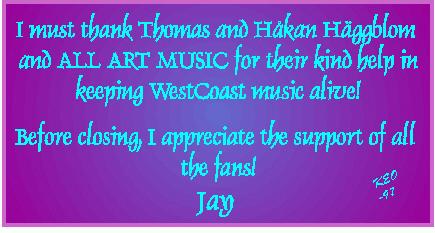

A note from Jay. The following is long overdue. I would like to thank Kerstin for putting together an incredible web site!!! She does this in her spare time and I have always been amazed that a mother of three with a full time job could possibly maintain such a web site!!! OK, that alone is unbelievable but check this out!!! Kerstin knows more about my songwriting catalogue than I do!!! She has organized and maintained the list for many years. Her research has led to problems and she then fixes such problems!!! The discography is huge work as well!!! Kerstin constantly updates which is a huge time burner!!! Now check this out!!! Kerstin runs my record company SONIC THRUST RECORDS on a daily basis!!! It does not end there since other stuff comes up on many levels!!! Kerstin should be a star of a TV series, "Internet Super Women"!!! I thank you so very much Sis!!! You are an angel!!!!!!! I ask that if you like this site, please e-mail Kerstin and tell her so. Please include Lage (her husband), Peppe and Stefan (their sons) since they have contributed as well!!! I love this family for so many reasons!!!!!!!!!!!! - Your pal, Jay
All written material, all images and photos in all sections of this website copyright © Jay Graydon/KEO 1996 - 2024. All rights reserved. Comments, suggestions, appreciation, corrections... whatever... talk to us.  Intro Page
 E-mail us!
|
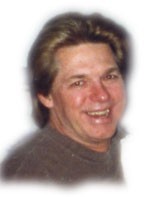 Did you know that Jay is an unbelievable card magician and has been into card magic for
many years? I
bet you didn't....and that he loves Italian food and collects fine wines? Well, now you know.
Regarding films, he says old comedy is much fun, like W.C. Fields, the Marx Bros, Laurel and
Hardy and many more. Most of the Bogart films interest him and Hitchcock films are also some
of the best ever made in Jay's opinion.
Did you know that Jay is an unbelievable card magician and has been into card magic for
many years? I
bet you didn't....and that he loves Italian food and collects fine wines? Well, now you know.
Regarding films, he says old comedy is much fun, like W.C. Fields, the Marx Bros, Laurel and
Hardy and many more. Most of the Bogart films interest him and Hitchcock films are also some
of the best ever made in Jay's opinion. The Joe Graydon Show - BEFORE repairs